
Inhalt
How will GenAI transform software engineering?
Not just how we write code, but how entire software systems are developed and operated.
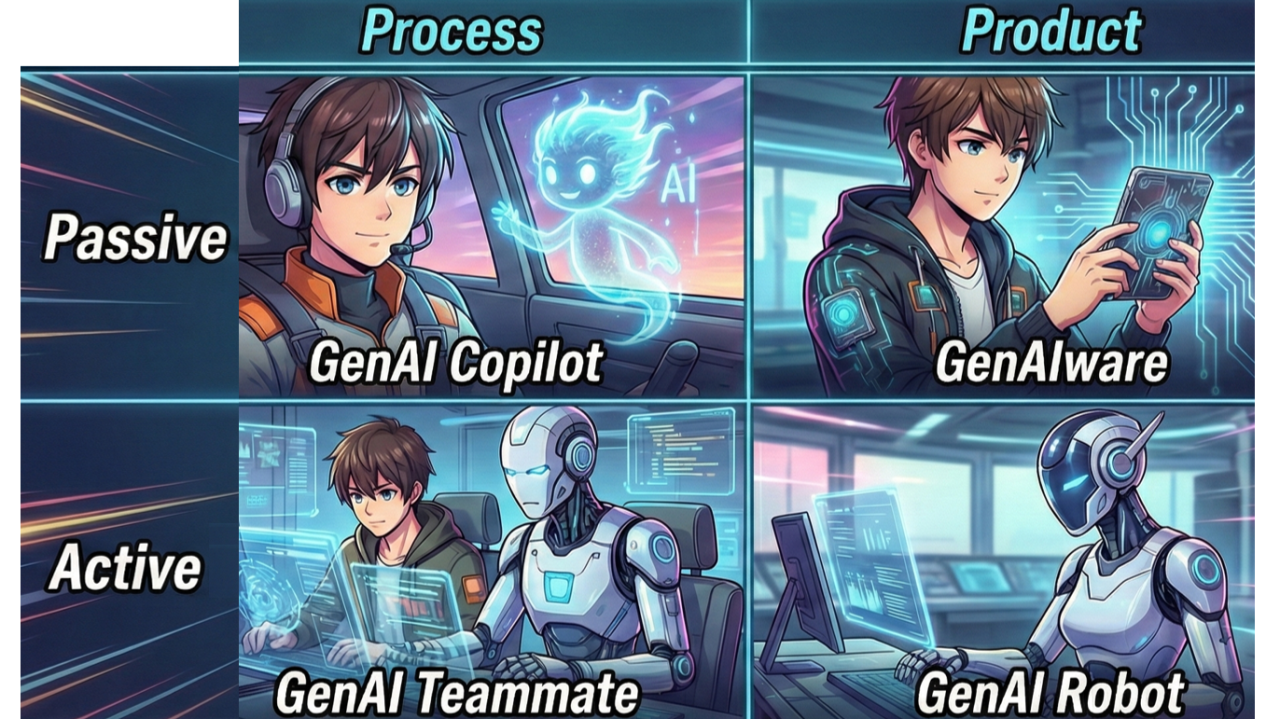
To answer this, we moved beyond vague buzzwords like "GenAI for SE." Instead, we introduced a rigorous framework that classifies GenAI in SE along two crucial dimensions:
1️⃣ What is being augmented?
- SE Processes: Using AI to automate developer tasks (e.g., code or test generation)
vs. - Software Products: Replacing explicitly programmed features with embedded AI functionality
2️⃣ How autonomous is the AI?
- Passive: Responding directly to user prompts and inputs
vs. - Active (Agentic): Operating with its own thread of control, making proactive and semi-autonomous decisions
The intersection of these dimensions creates four distinct forms of GenAI augmentation shown below.
To find out more...
- Read our Open Access ACM TOSEM article "A Research Roadmap for Augmenting Software Engineering Processes and Software Products with Generative AI": https://doi.org/10.1145/3788879
- Check out the Rapid Literature Review (RLR) results: https://zenodo.org/records/18345896
- Download the our ACM FSE 2026 Journal First presentation: PDF Slides
- See our Top 10 predictions for Software Enginnering in 2030 and how the FSE audience assessed them: Results Slide
- To learn about additional research challenges for GenAI Robots, explore our Information Systems research manifesto on "Agentic Business Process Management": https://doi.org/10.1016/j.is.2026.102738
- To learn about how to shape GenAI Teammates, explore our BPM 2026 paper on "Using Process Mining to Generate AI Agents from Software Engineering Process Records": https://doi.org/10.48550/arXiv.2607.04948
How will AI Agents transform BPM?
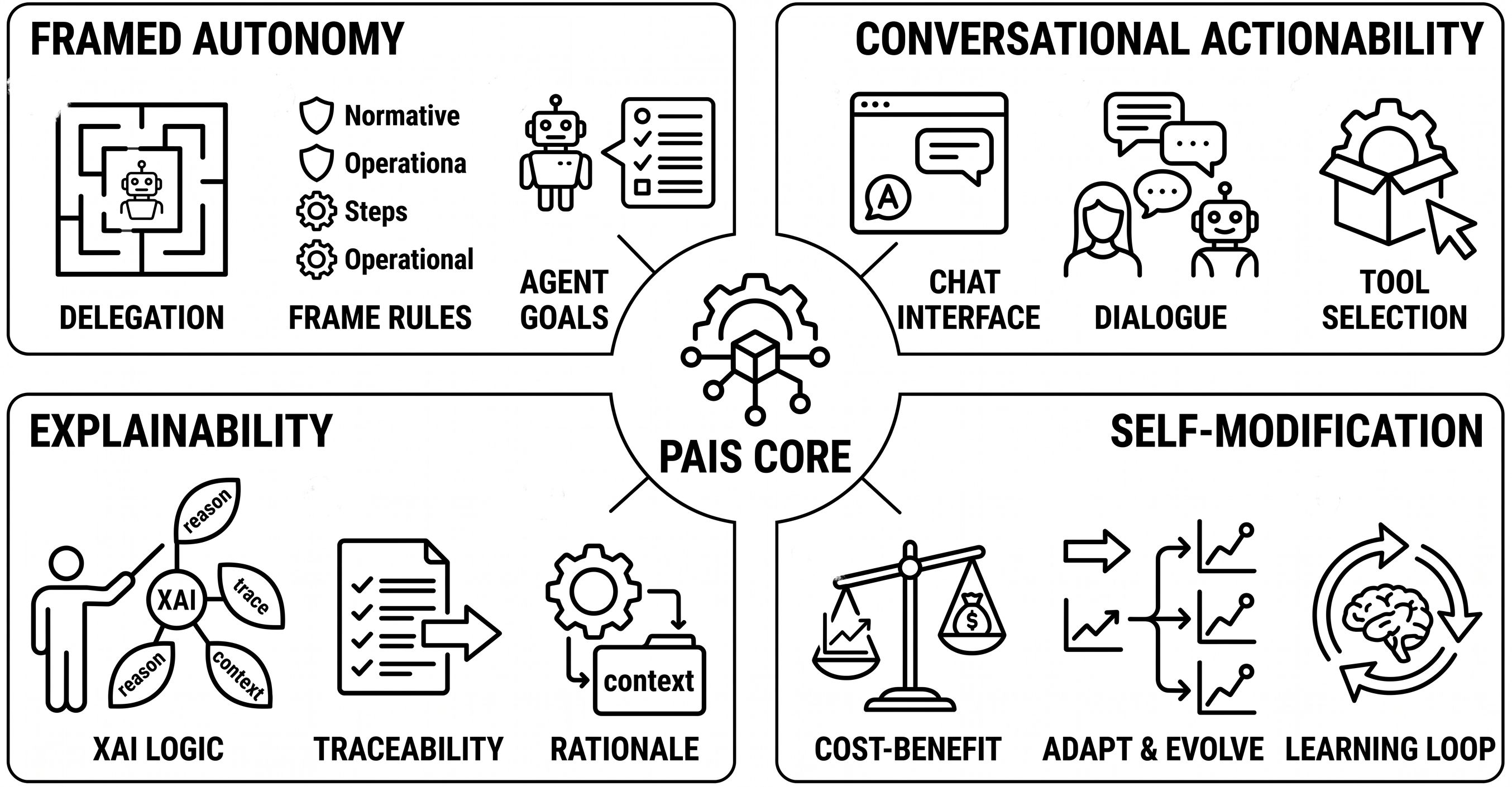
We observe a major shift from "traditional" BPM systems, which were automation-oriented, process-aware systems executing predefined activities and tasks to Agentic BPM systems. Where Robotic Process Automation (RPA) facilitated automation of repetitive, clearly defined tasks in "traditional" BPM, the level of autonomy and automation will reach new levels in Agentic BPM via the collaboration of human actors and AI agents.
Agentic BPM systems need to exhibit the following four capabilities:
To find out more...
- Read our Open Access Elsevier Information Systems article "Agentic Business Process Management: A research manifesto": https://doi.org/10.1016/j.is.2026.102738
- Download the our BPM 2026 Journal First presentation: PDF Slides
Tutorial zu "AI-Assisted Business Process Monitoring" auf der BPM 2025 Konferenz
Folien: PDF
Tutorial Summary: PDF, Erschienen in: A. Senderovich, C. Cabanillas, I. Vanderfeesten, H. A. Reijers: Business Process Management, 23rd International Conference, BPM 2025, Seville, Spain, August 31 – September 5, 2025, Proceedings, Springer, LNCS, pp. xxv-xxviii; https://doi.org/10.1007/978-3-032-02867-9
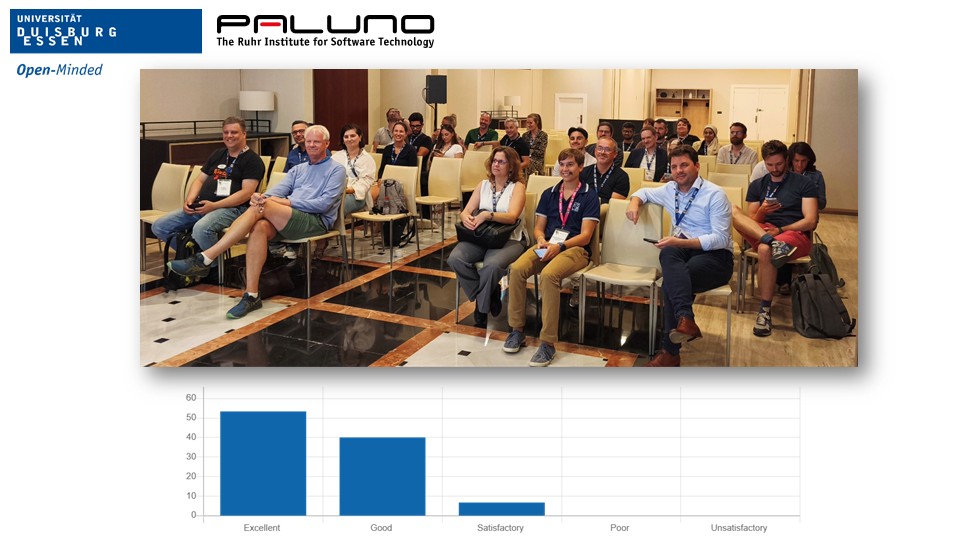
Foto und Umfrageergebnisse des Tutorials:
Seminar Adaptive Systeme im SoSe 2025
Organisatorisches
- Die Anmeldung zum Seminar ist geschlossen!
- Weitere Infos auch im LSF
- Das Seminar wird gemeinsam betreut mit Prof. Dr. Andreas Vogelsang (zum SoSe an der UDE)
Thema: "Generative KI im Software Engineering"
Das Seminar beschäftigt sich mit dem Einsatz generativer KI entlang des Software-Lebenszyklus. Generative KI gewinnt zunehmend an Bedeutung, vor allem durch immer leistungsfähigere Large Language Models (LLMs) wie z.B. ChatGPT, Gemini, Claude, etc.
Der mögliche Einsatz generativer KI im SE ist im Folgenden an einer erweiterten Variante des DevOps-Modells illustriert.
Basierend auf Ihrem Interesse und eventuellem Vorwissen (aus andere Vorlesungen etc.) wählen Sie einen konkreten Anwendungsbereich als Thema für Ihr Seminar.
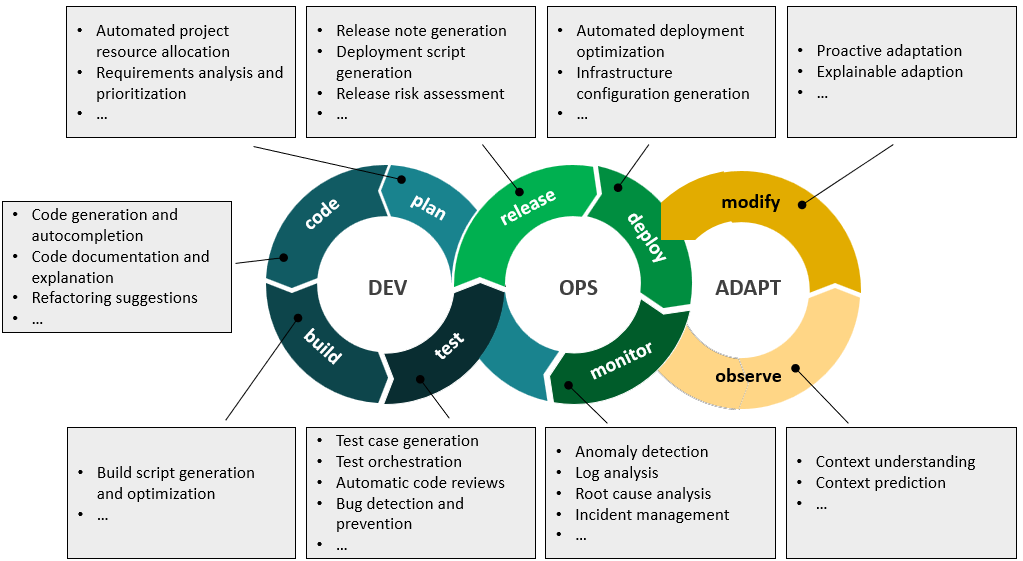
Anwendungsbereiche für generative KI im DevOpsAdapt-Software-Lebenszyklus [Bildquelle]
Aufbau der Seminararbeit
Ihre Seminararbeit umfasst die folgenden wesentlichen Teile:
- T1: Grundlagen und Vorgehensweise
- T2: State of the Art
- T3: Praktisches Beispiel
- T4: Kritische Diskussion
Ablauf des Seminars
Das Seminar ist entlang der folgenden Meilensteine / Termine strukturiert:
- Einführungsveranstaltung
- Themenwunsch
- Workshop „Wissenschaftliches Arbeiten“ (Teil 1: Recherche & Schreiben)
- Teil T1 der Arbeit an Betreuer für Feedback
- Teile T2 und T3 an Betreuer für Feedback
- Workshop „Wissenschaftliches Arbeiten“ (Teil 2: Präsentieren)
- Präsentation zu den Teilen T1 – T3
- Abschlusspräsentation (mit Fokus auf Teil T4)
- Finale Abgabe der Arbeit
Fragen
Gerne an
Studium
- Ankündigung: WiSe 2026/27 - Master-Vorlesung "Process-Aware Information Systems (PAIS)"
- Weitere Informationen: siehe hier: https://sse.uni-due.de/teaching