
How will GenAI transform software engineering?
Not just how we write code, but how entire software systems are developed and operated.
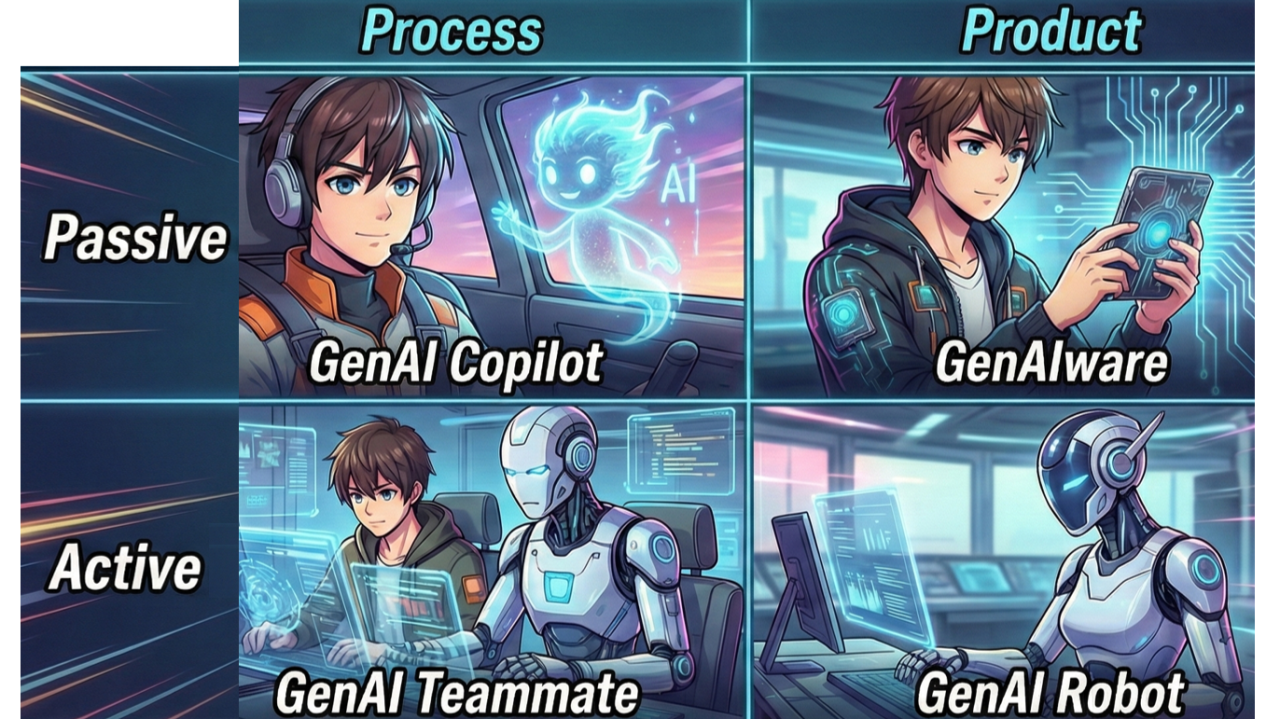
To answer this, we moved beyond vague buzzwords like "GenAI for SE." Instead, we introduced a rigorous framework that classifies GenAI in SE along two crucial dimensions:
1️⃣ What is being augmented?
- SE Processes: Using AI to automate developer tasks (e.g., code or test generation)
vs. - Software Products: Replacing explicitly programmed features with embedded AI functionality
2️⃣ How autonomous is the AI?
- Passive: Responding directly to user prompts and inputs
vs. - Active (Agentic): Operating with its own thread of control, making proactive and semi-autonomous decisions
The intersection of these dimensions creates four distinct forms of GenAI augmentation shown below.
To find out more...
- Read our Open Access ACM TOSEM article "A Research Roadmap for Augmenting Software Engineering Processes and Software Products with Generative AI": https://doi.org/10.1145/3788879
- Check out the Rapid Literature Review (RLR) results: https://zenodo.org/records/18345896
- Download the our ACM FSE 2026 Journal First presentation: PDF Slides
- See our Top 10 predictions for Software Enginnering in 2030 and how the FSE audience assessed them: Results Slide
- To learn about additional research challenges for GenAI Robots, explore our Information Systems research manifesto on "Agentic Business Process Management": https://doi.org/10.1016/j.is.2026.102738
- To learn about how to shape GenAI Teammates, explore our BPM 2026 paper on "Using Process Mining to Generate AI Agents from Software Engineering Process Records": https://doi.org/10.48550/arXiv.2607.04948